
ZWO ASI 120mm Mini Camera Quick Review
A reliable entry-level guide camera after more than five years of use
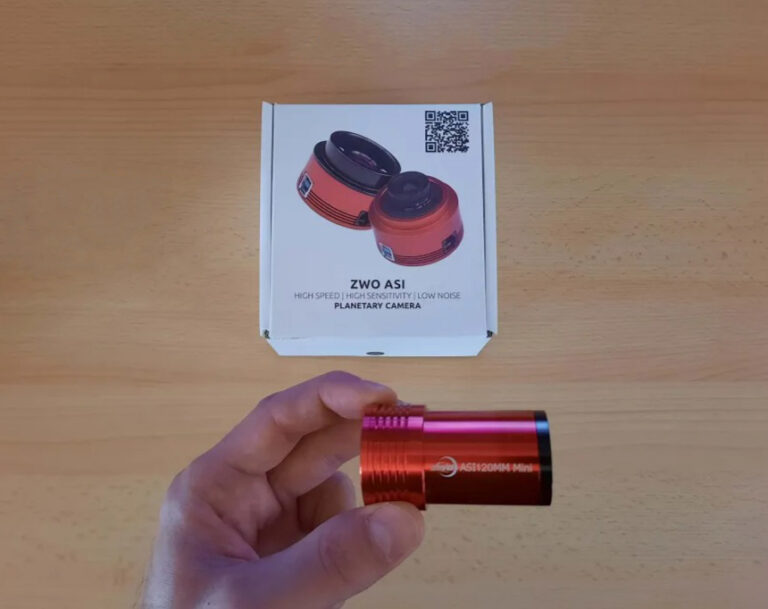
When I first started astrophotography, I captured most of my images without autoguiding. From what I had seen online, guiding looked complicated, so I avoided it for a while. As my exposure times increased, however, I became increasingly frustrated by elongated stars and the limitations of relying on the mount alone.
I eventually decided to buy one of the most widely recommended entry-level guide cameras: the ZWO ASI120MM Mini. Setting up PHD2, connecting the mount and completing the first calibration took some patience, but the improvement that came from adding autoguiding made the effort worthwhile.
More than five years later, the ASI120MM Mini is still part of my imaging setup. I have used it almost exclusively as a guide camera, and it has remained dependable throughout that time. It is no longer the newest model available, but for many modest guide-scope setups it continues to offer a practical combination of low weight, sufficient sensitivity and reasonable cost.
Quick verdict: The ASI120MM Mini remains a very good first guide camera for typical guide-scope setups. Its main limitation is its relatively small sensor, which can make finding guide stars more difficult when used with an off-axis guider or at longer focal lengths.
My Experience Using It for Autoguiding
The greatest improvement did not come from the camera alone, but from introducing autoguiding into my workflow. With the ASI120MM Mini attached to a small guide scope and controlled through PHD2, the mount can make continuous corrections while the main camera is taking longer exposures. This significantly reduced the number of frames I had to reject because of tracking errors and gave me more consistently round stars.
In normal use, the camera has been straightforward and reliable. Its monochrome sensor is sensitive enough to detect suitable guide stars in the areas of the sky I typically photograph, and its narrow cylindrical body makes it easy to insert into a guide scope and adjust for focus. At only 60 grams, it adds very little weight to the imaging setup.
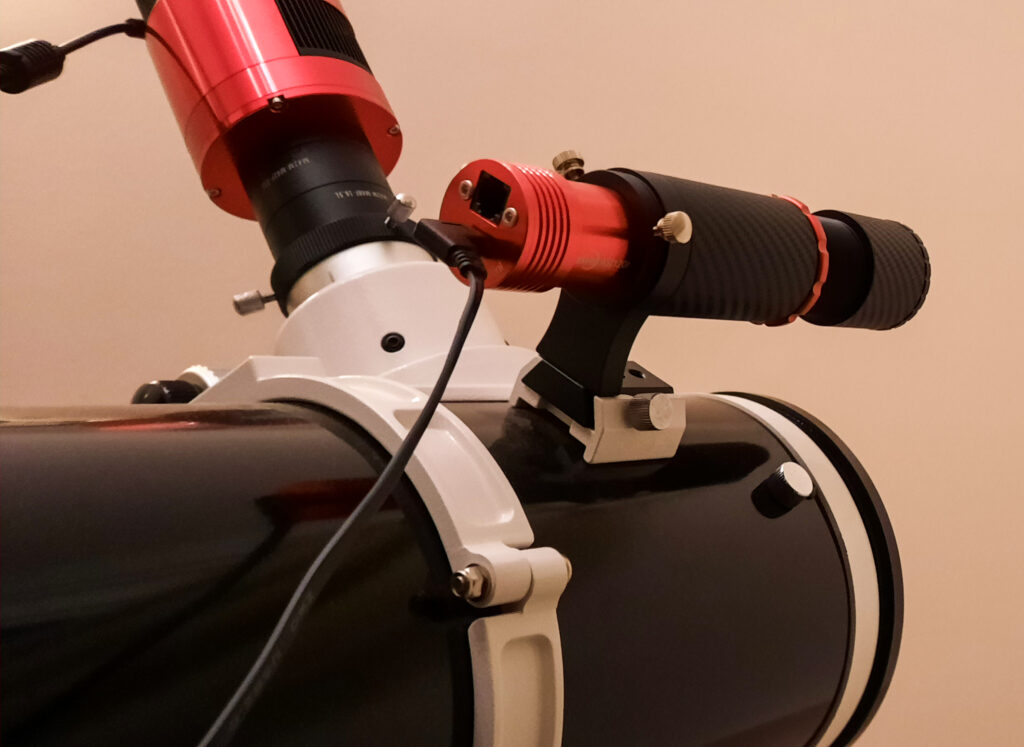
Key Specifications
Specification | ASI120MM Mini |
Sensor | 1/3-inch AR0130CS monochrome CMOS |
Resolution | 1280 x 960 (approximately 1.2 megapixels) |
Pixel size | 3.75 micrometres |
Sensor area / diagonal | 4.8 x 3.6 mm / 6.09 mm |
Maximum frame rate | 35 frames per second at full resolution |
ADC | 12-bit |
Peak quantum efficiency | Almost 80%, according to ZWO |
Read noise | Approximately 4.0-6.5 electrons, depending on gain |
Shutter | Rolling shutter |
Connections | USB 2.0 Type-C and ST-4 guide port |
Weight | 60 g |
Cooling | None |
Connections and Guide Method
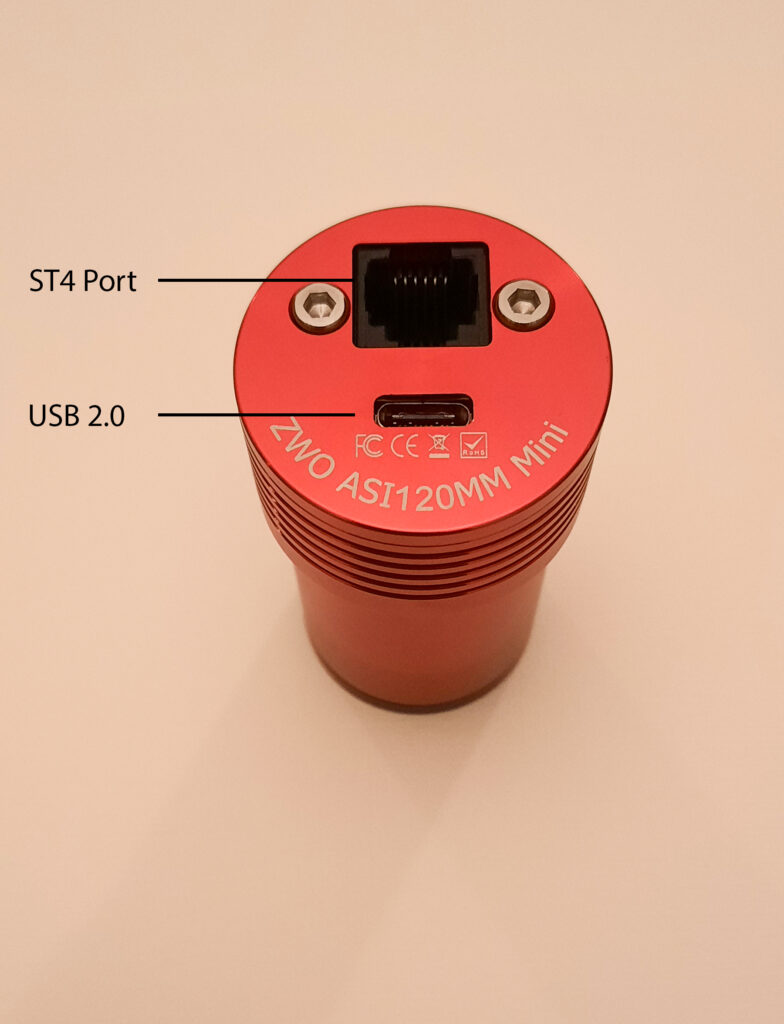
The rear of the camera has a USB 2.0 Type-C port for connecting it to a computer or controller, along with an ST-4 guide port. The ST-4 port allows guide commands to be sent from the camera directly to the mount using the supplied guide cable.
I initially used ST-4 guiding, but later moved to ASCOM pulse guiding through the mount’s computer connection. PHD2 recommends ASCOM on Windows, or INDI on supported systems, when the mount supports it. This removes the additional ST-4 cable and allows PHD2 to receive information such as the telescope’s pointing position and side of pier, making calibration management and troubleshooting easier. It is more accurate to describe this as a better-connected and more convenient workflow rather than claiming that it automatically produces better guiding in every setup
Can it be Used for Lunar and Planetary Imaging?
Although I have mainly used the ASI120MM Mini for guiding, it can also capture the Moon and planets. It records up to 35 frames per second at full resolution, and higher frame rates are possible when a smaller region of interest is selected. The small sensor is not a problem for compact targets such as planets, although it does create a relatively narrow field of view.
There are some important limitations. This is a monochrome camera, so producing colour planetary images requires separate colour filters and additional processing. It also uses USB 2.0 and is slower than many newer dedicated planetary cameras. It is therefore best viewed as a guide camera that can also perform basic monochrome lunar and planetary imaging, rather than as the strongest choice for someone whose main priority is high-speed planetary work.
What was included with my camera: the ASI120MM Mini, a 1.25-inch cover and extender, an M28.5-to-CS adapter, an ST-4 guide cable, two USB 2.0 Type-C cables (0.5 m and 2 m), and a quick-start guide. Package contents can change over time and may vary by dealer.
Price and Value
Astrophotography becomes expensive quickly, and autoguiding adds another camera, a guide scope or off-axis guider, and the necessary cables or control hardware. The ASI120MM Mini has remained popular partly because it sits toward the affordable end of ZWO’s guide-camera range. At the time of this update, ZWO lists it at US$149, although local pricing, taxes and availability vary considerably by country.
For a beginner using a conventional guide scope, it still offers good value. However, buyers should also consider how they plan to guide. The ASI120MM Mini’s small sensor provides a narrower field of view than newer or larger-sensor models. That is rarely a serious problem with a short guide scope, but it can make suitable guide stars harder to find when using an off-axis guider, particularly at longer focal lengths. In those situations, paying more for a larger or more sensitive sensor may be worthwhile.
Strengths and Weaknesses
Strengths
Reliable over more than five years of regular use
Very light and compact (60 g)
Sensitive enough for many guide scope setups
Standard 1.25-inch form factor
Affordable entry point into autoguiding
Can also be used for basic lunar and planetary imaging
Limitations
Small sensor with a relatively narrow field of view
Less suitable for demanding off-axis guiding setups
USB 2.0 limits planetary frame rates compared to newer cameras
Monochrome only; color planetary imaging requires RGB filters
Newer guide cameras may offer greater sensitivity or larger sensors
Final Verdict
After more than five years of use, I remain very satisfied with the ZWO ASI120MM Mini. It has been dependable, easy to integrate into my setup and fully adequate for the type of guide-scope-based imaging I do. The substantial improvement I saw in my images came from autoguiding as a whole, but this camera has performed its role reliably night after night.
I would still recommend it to beginners who want a proven and relatively affordable first guide camera for a small guide scope. Those planning to use an off-axis guider, image at long focal lengths or build a more demanding setup should compare it with newer, larger-sensor alternatives before buying. For the right setup, however, the ASI120MM Mini remains a capable little camera that continues to do exactly what I need it to do.
My Original Video Review
Some years ago I published a video review of this camera. See below.